A Practical Guide for Product & UX Teams
Product teams are under constant pressure to move faster, test earlier, and make decisions with incomplete information. Traditional user research remains essential, but it is often slow, expensive, or impossible early on. This gap has created space for a new class of tools and methods: testing with synthetic users.
Synthetic users are not a replacement for real people. Used well, they are a way to explore ideas, stress-test assumptions, and narrow down what is worth validating with real users. Used poorly, they can create false confidence and reinforce existing biases.
This guide explains what synthetic users are, when they are useful, how teams are applying them today, and how to validate their outputs responsibly.
What Are Synthetic Users?
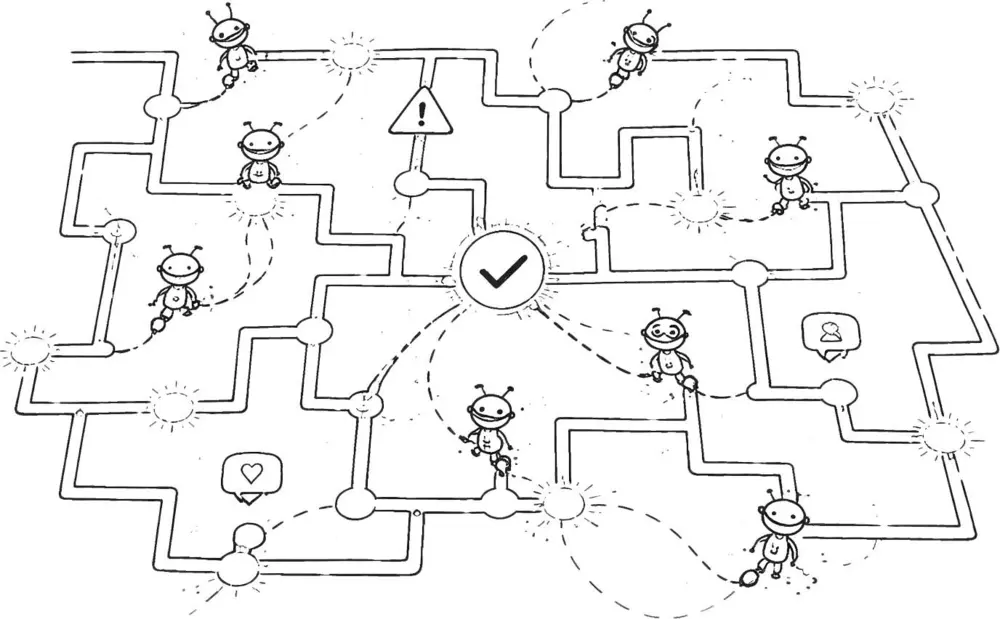
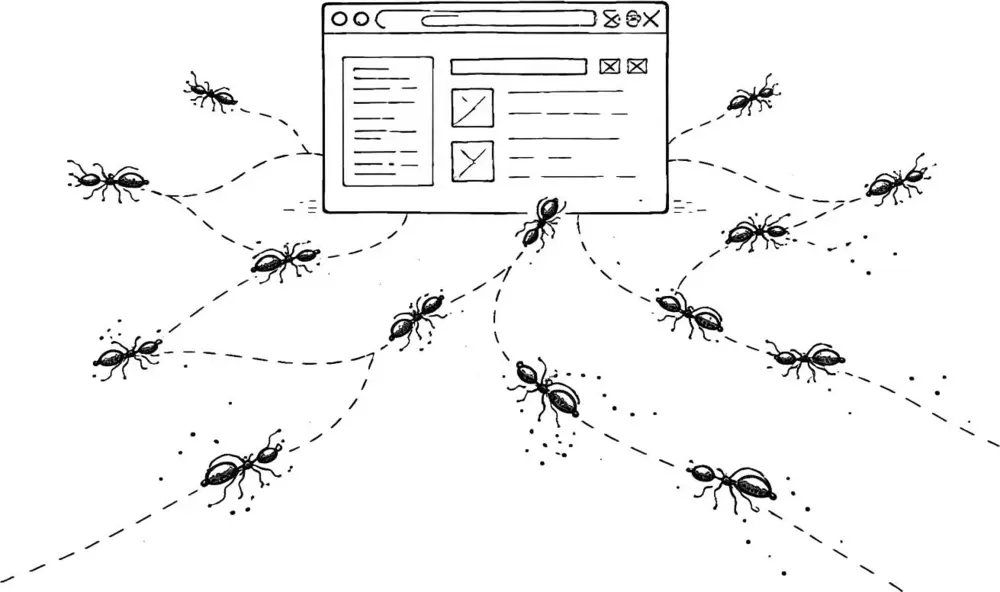
Synthetic users are AI-generated representations of user behavior, preferences, or decision-making. They are typically produced by large language models or agent-based systems that simulate how certain user types might respond in a given context.
You will also see related terms used interchangeably:
- Synthetic personas – often static or semi-static profiles used to guide simulations
- Simulated users – a broader term that may include rule-based or agent-based models
- Digital twins – more common in engineering and operations, sometimes adapted to user modeling
In practice, synthetic users works best as an umbrella term. It describes systems that can generate user-like responses without recruiting real people.
The key distinction is this: synthetic users do not observe the world or experience products. They infer behavior based on patterns learned from data.
Why Teams Are Turning to Synthetic User Testing
Most teams do not adopt synthetic users because they distrust real user research. They adopt them because real research does not always fit the moment.
Common drivers include:
- Speed: Teams can explore ideas in hours instead of weeks
- Cost: Once set up, additional simulations are inexpensive
- Early-stage uncertainty: There may be no users yet, or no traffic to test against
- Access gaps: Some audiences are hard to recruit or expensive to reach
Synthetic users are especially attractive when decisions are still reversible and the goal is learning, not proof.
What You Can Test With Synthetic Users (and What You Can’t)
Synthetic users are best used for directional insight, not final validation.
Common Use Cases
- Early A/B exploration. Before running live experiments, teams can test variants at the pull request or design-review stage to see which direction looks more promising.
- UX and copy evaluation. Synthetic users can react to flows, onboarding steps, or messaging to surface clarity issues and comprehension gaps.
- Virtual surveys and feedback loops. Teams can generate large volumes of synthetic survey responses to identify likely points of friction or preference clusters.
- Hypothesis generation. Rather than starting research with a blank page, teams can use simulations to generate candidate explanations for user behavior.
- Expert-style critique. Some teams simulate expert reviewers to flag usability or consistency issues before human review.
Where Synthetic Users Fall Short
- Measuring true emotional response
- Capturing real-world constraints and trade-offs
- Replacing high-stakes validation or end-to-end research
If the decision is costly or irreversible, synthetic users should not be the final input.
When Should You Use Synthetic Users?
A useful way to think about synthetic user testing is through problem clarity and decision risk.
| Low risk | High risk | |
|---|---|---|
| High clarity | Useful for early exploration, pattern discovery, and rapid iteration. | Helpful for hypothesis generation, but real-user validation is required. |
| Low clarity | Can surface ideas and possibilities, but results should be treated as directional only. | Not a good fit. Simulation alone is insufficient. |
Synthetic users are strongest when the cost of being wrong is low and the value of speed is high.
How to Validate Synthetic User Insights
The most important question teams ask is not “are synthetic users accurate?” but “how do we know when to trust them?”
Several validation lenses are useful:
- Directional agreement. Do synthetic insights point in the same direction as real A/B tests or past research, even if the magnitude differs?
- Calibration gap. How large is the difference between predicted behavior and observed outcomes, and does it stay consistent over time?
- Use-case reliability. Which types of problems produce stable outputs (for example, copy clarity versus pricing sensitivity)?
- Stability over time. Do results change significantly when prompts, models, or input data change?
Validation is not a one-time step. It is an ongoing process of comparison and recalibration.
Strengths and Limitations
Strengths
- Fast iteration cycles
- Low marginal cost
- Ability to explore many scenarios quickly
- Useful for narrowing the research space
Limitations
- Risk of false confidence
- Lack of lived experience, emotion, and consequence
- Outputs reflect training data and assumptions, not reality
The most common failure mode is treating synthetic output as evidence rather than input.
The synthetic user landscape
The ecosystem around synthetic users is developing quickly. Tools generally fall into three categories:
- Survey-focused tools that generate large volumes of structured responses
- Behavioral simulation tools that model flows and decision paths
- Interview-style tools that simulate qualitative conversations
Most teams experiment with these tools before committing them to core workflows. Maturity varies widely.
Synthetic user and automated exploration tools
- Jina Synthetic Users — https://synthetic.usejina.com/
AI agents configured to explore applications and report on interactions and issues. - SyntheticUsers.com — https://www.syntheticusers.com/
A service focused on generating synthetic user behaviors for research and early-stage validation. - UXIA Synthetic Users Tools — https://www.uxia.app/blog/synthetic-users-tools
A curated overview of tools designed to simulate user interactions for usability research and testing. - testRigor — https://testrigor.com/
An AI-driven automated testing tool that explores application flows using plain-language test descriptions. - Mabl — https://www.mabl.com/
A testing platform that applies machine learning to automate and maintain end-to-end workflow checks. - testers.ai — https://testers.ai/
A service that generates and executes automated tests across web and mobile applications. - test.io — https://test.io/
A crowdsourced testing platform using human testers, often used alongside synthetic or automated tools.
Closing thoughts
Synthetic users change the economics of early research. They make it easier to ask more questions sooner and to explore ideas that would otherwise be skipped.
They do not make decisions safe on their own.
Teams that succeed with synthetic users are clear about what the method can and cannot do. They use it to think better, not to prove they are right.
Used this way, synthetic users are not a replacement for user research. They are a way to do more of it, earlier, and with more focus.
Sources
1 Synthetic monitoring simulates user behavior to detect issues by Dash0
2 Boost IT reliability with synthetic testing by Checkmk
3 Frontend Synthetic Monitoring: What is it, Types & Use Cases by ChecklyHQ
4 The 12 Best Synthetic Users Tools for Smarter Testing by UXIA
5 Synthetic Users by SyntheticUsers.com
6 Synthetic Users by Jina by Jina
7 Synthetic Users for Early-Stage Validation by Prajwal Paudyal
8 Synthetic Users: If, When, and How to Use AI-Generated Research Participants by Nielsen Norman Group
9 How to Use Synthetic Monitoring to Predict User Issues by Landon
