People tend to choose the path that requires the least effort. When something is easy to do, they do it. When it requires too much effort, they delay, abandon, or avoid the task entirely.
In interface design, this effort can be described as interaction cost.
Interaction cost is the total physical and mental effort required to complete a task. Looking, scrolling, searching, reading, clicking, waiting, typing, thinking, and remembering all add to it. The higher the interaction cost, the harder it becomes for someone to achieve their goal.
Reducing interaction cost increases the likelihood that users complete the behaviors your product depends on.
Interaction Cost and Human Behavior
The importance of effort is reflected in behavioral science.
The Fogg Behavior Model states that behavior happens when Motivation, Ability, and a Prompt occur at the same moment. Ability refers to how easy the behavior is to perform. When something is easier, less motivation is required for the behavior to happen.
The COM-B model describes behavior as the result of Capability, Opportunity, and Motivation. Interaction cost affects both capability and opportunity. When a task requires less effort, more people are capable of completing it and the environment better supports the behavior.
Both models highlight the same idea. Increasing motivation is difficult, but reducing effort is often straightforward. When interaction cost is low, behavior becomes more likely.
Interaction Cost Is Measurable
One of the useful aspects of interaction cost is that it can be measured.
One of the useful aspects of interaction cost is that it can be measured.
Unlike vague usability principles, interaction cost can often be approximated through observable actions such as the number of clicks or taps, the amount of scrolling, pointer movement, typing, decisions required, and the time needed to complete a task.
These small efforts accumulate. A single extra step may not seem significant, but across a flow they compound into noticeable friction.
This is one reason why simple applications that focus on doing a specific task efficiently are often successful. As products gain more features, interaction costs tend to increase. Keeping effort low becomes harder but also more important.
Types of Interaction Cost
Interaction cost comes from both physical and cognitive effort.
- Physical cost includes actions such as clicking, tapping, scrolling, typing, and moving the pointer across the screen.
- Cognitive cost includes reading text, interpreting labels, remembering information, comparing options, and making decisions.
Decision cost deserves special attention. When users are presented with too many options, the time required to choose increases. This relationship is described by Hick’s Law, which states that decision time increases with the number and complexity of choices.
Too many options can also lead to analysis paralysis, where people delay or avoid decisions altogether.
Reducing interaction cost therefore involves minimizing both physical actions and mental effort.
Practical Ways to Reduce Interaction Cost
Several well-known design principles help reduce interaction cost.
Keep related actions close
According to Fitts’s Law, the closer and larger a target is, the faster it is to interact with it. Actions should be placed near the elements they relate to, and interactive targets should be large enough to select comfortably. A target size of around 48 × 48 points is a safe minimum for touch interfaces.
Reduce distractions
Animated banners, pop-ups, and unnecessary visuals compete for attention. When attention shifts away from the task at hand, cognitive effort increases. Interfaces should guide attention toward the primary task rather than competing for it.
Minimise choice
Reducing the number of visible options speeds up decision making. When many options are necessary, highlighting recommended or popular choices can help users decide faster and avoid analysis paralysis.
Use sensible defaults
Defaults are one of the simplest ways to reduce interaction cost. When a common option is already selected, users can proceed without making a decision. Because of status quo bias, people often stick with the default option, which reduces both effort and time.
Prefer recognition over recall
Information that can be recognized is easier than information that must be remembered. Familiar patterns, clear labels, and visual cues reduce the mental effort required to interpret an interface.
Example: Reducing Interaction Cost in Form Inputs
Consider a form where a user needs to select their country.
In the first version, the interface presents a long dropdown list containing every country in the world. To select their country, the user must click the dropdown, scroll through a long list, visually scan for their country, and click it.
The interaction cost includes one click to open the dropdown, scrolling through a large list, searching visually for the correct option, and clicking again to select it. The cognitive effort is significant because the user must scan and process a long list of options.
In a revised version, the interface replaces the dropdown with a searchable input field. As soon as the user begins typing the name of their country, matching options appear in a short list.
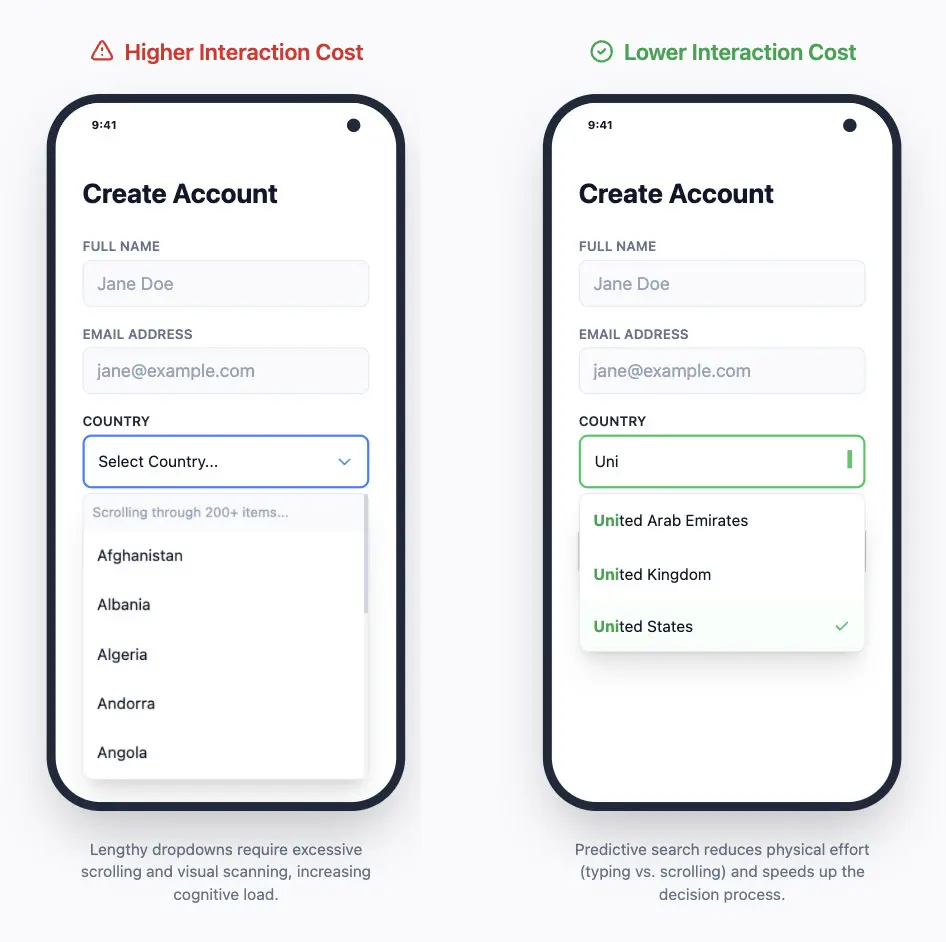
Instead of scanning dozens of options, the user can type a few letters and select the correct result.
The interaction cost drops significantly. The user no longer needs to scroll or visually search through a long list. The interface adapts to their input and narrows the available choices.
Small changes like this can remove unnecessary effort and make common tasks faster to complete.
Across an entire interface, these reductions in effort accumulate. What feels like a minor improvement in one component can lead to a noticeably smoother experience overall.
Design Is the Management of Effort
Every interface requires effort from users. The role of design is to manage that effort carefully.
Every interface requires effort from users. The role of design is to manage that effort carefully.
When interaction cost is low, users can achieve their goals quickly and confidently. When it is high, even motivated users may hesitate or abandon the task.
Reducing interaction cost is therefore one of the most reliable ways to improve usability. Small reductions in effort, repeated across an interface, can make the difference between a product that feels frustrating and one that feels effortless.
Sources
1 Interaction cost definition by Raluca Budiu at Nielsen Norman Group
2 Making the Fogg Behavior Model actionable at UI-Patterns
3 Designing for Change: Using the COM-B Model to Drive Behavior Change at UI-Patterns
4 Analysis Paralysis by Anders Toxboe at Learning Loop
5 Hick’s Law at the Decision Lab
6 Fitt’s Law at Wikipedia
7 Tunneling design pattern by Learning Loop
