Making Sense of Complexity
Conference talk at Lean, Agile & Scrum Conference
· 71 min
Recorded at the Lean, Agile & Scrum Conference in 2013, this philosophical talk by Dave Snowden, a Welsh researcher in knowledge management, can be hard to grasp on first viewing, but it rewards pausing and replaying. Snowden explains his sense-making methodology, which helps define the proper boundary conditions between methods and tools.
He explores three concepts. Exaptation means taking something designed for one purpose and using it for something with a completely different utility; he argues it is a far more successful innovation strategy than adaptation, and that designing for it needs good architecture, scaffolding and finely grained objects. Coherence is not the same as perfect: with coherence you can experiment and prototype. And complexity is something you absorb rather than eliminate, by guiding flow and managing turbulence instead of imposing structure. Software development, he says, should be seen as an evolutionary, parallel service rather than a linear manufacturing process.
Snowden contrasts the ordered, complex and chaotic ontologies, each with different causality, and criticises management methods, agile included, that assume one prescription fits all. He talks about managing networks rather than people, managing the evolutionary potential of the present, why transparency can be the enemy of innovation, and proposes “See, Attend, Act” in place of “Plan, do, check, act”.
What you'll learn
- Exaptation as a more successful innovation strategy than adaptation
- Treating software development as an evolutionary service, not linear manufacturing
- Absorbing complexity instead of trying to eliminate it
- Order, complex and chaos ontologies call for different ways of acting
- Why total transparency can stop people taking risks and innovating

Watch next
-
Paul AdamsDon't Join the Cult
-
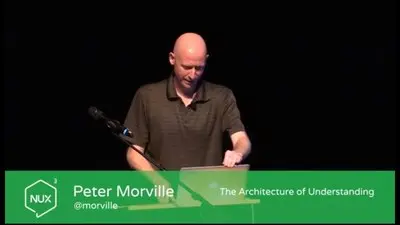
Peter MorvilleThe Architecture of Understanding
-
Christina WodtkeIdeas are cheap. Execution is everything.


Free weekly newsletter
Real UI patterns and design psychology in your inbox
Learn how successful products use UI patterns and behavioral design. One email a week from UI-Patterns.com and Learning Loop.
Subscribe