We have gone through the sign-up journeys of Airtable, Amplitude, Canva, Figma, Mailchimp, Netflix, Notion, Shopify, Slack and Trello (plus a few screens from Google), together with usage screens from Claude and Dropbox, and captured the screens along the way. Reading them side by side, a pattern emerges: onboarding is turning into a conversation.
The old flow was a form, a wizard and a checklist. The new flow often starts with a prompt box, a gallery of templates, or a block of text you are supposed to paste into your coding agent.
This post collects what we saw, what it means for onboarding design, and which UI patterns are changing shape as a result.
What we looked at
- 10 full sign-up journeys, a few Google screens and usage screens from Claude and Dropbox
- More than 150 screenshots, now added to the pattern library
- Captured in October 2026, so the screens reflect what new users see this month
Caveat: one sign-up per product is an observation, not a study. Many products run experiments, so you may see something different. Treat the trends as signals to test, not as proven best practice.
1. The prompt box is the new wizard
In the Airtable journey, there is no profile form. Instead, an assistant called Omni introduces itself (“I’m Omni, your Airtable data analyst”) and asks, one question at a time, where you work, what industry you are in and which team you are on. It then writes a starting prompt from your answers. You can accept it with Build it or ask for other ideas with Change suggestions.
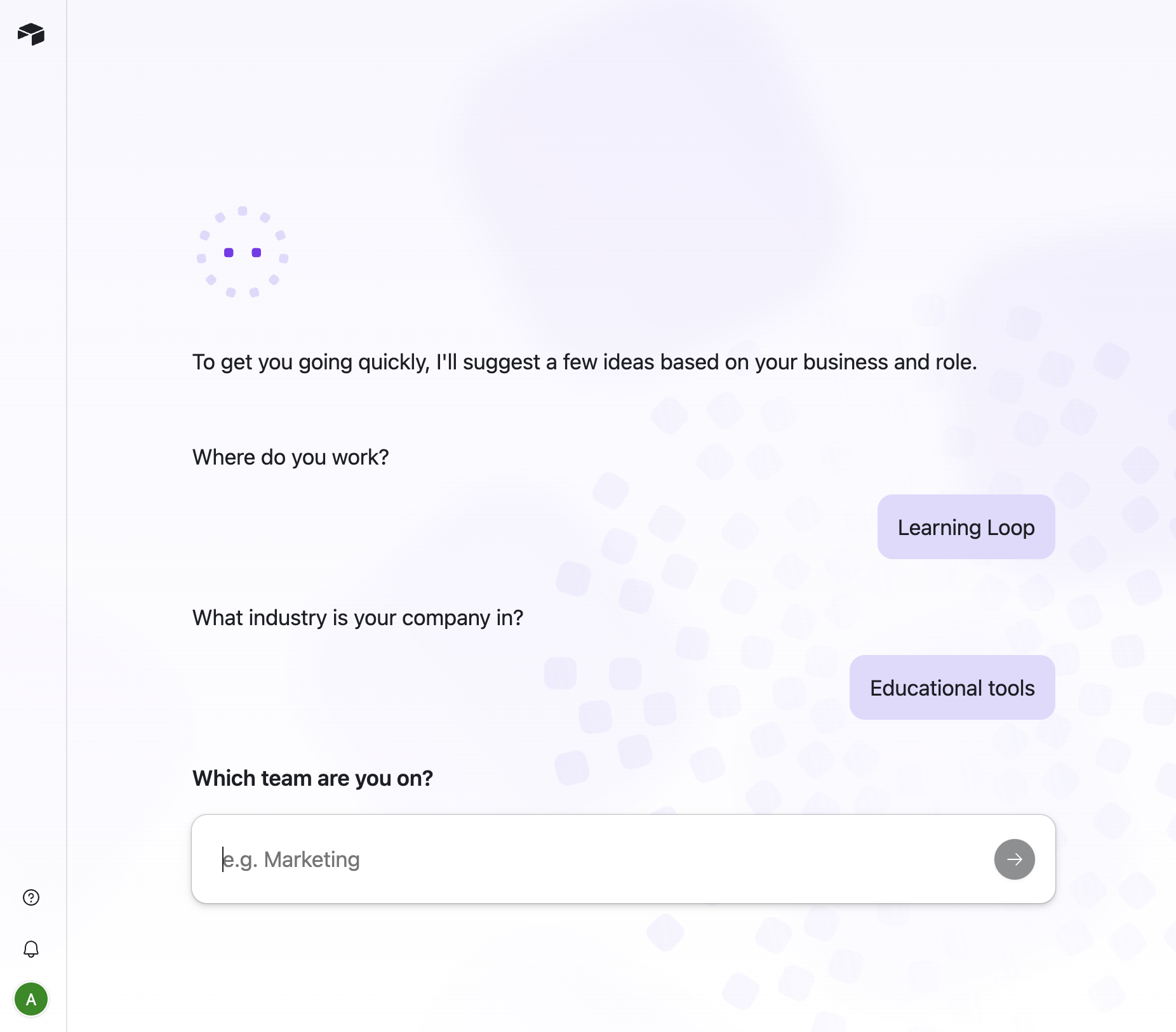
Airtable’s assistant asks about your business, one question at a time, before building anything.
That is a Personalization Form, a Wizard, Suggested Prompts and a preview, merged into a single conversation.
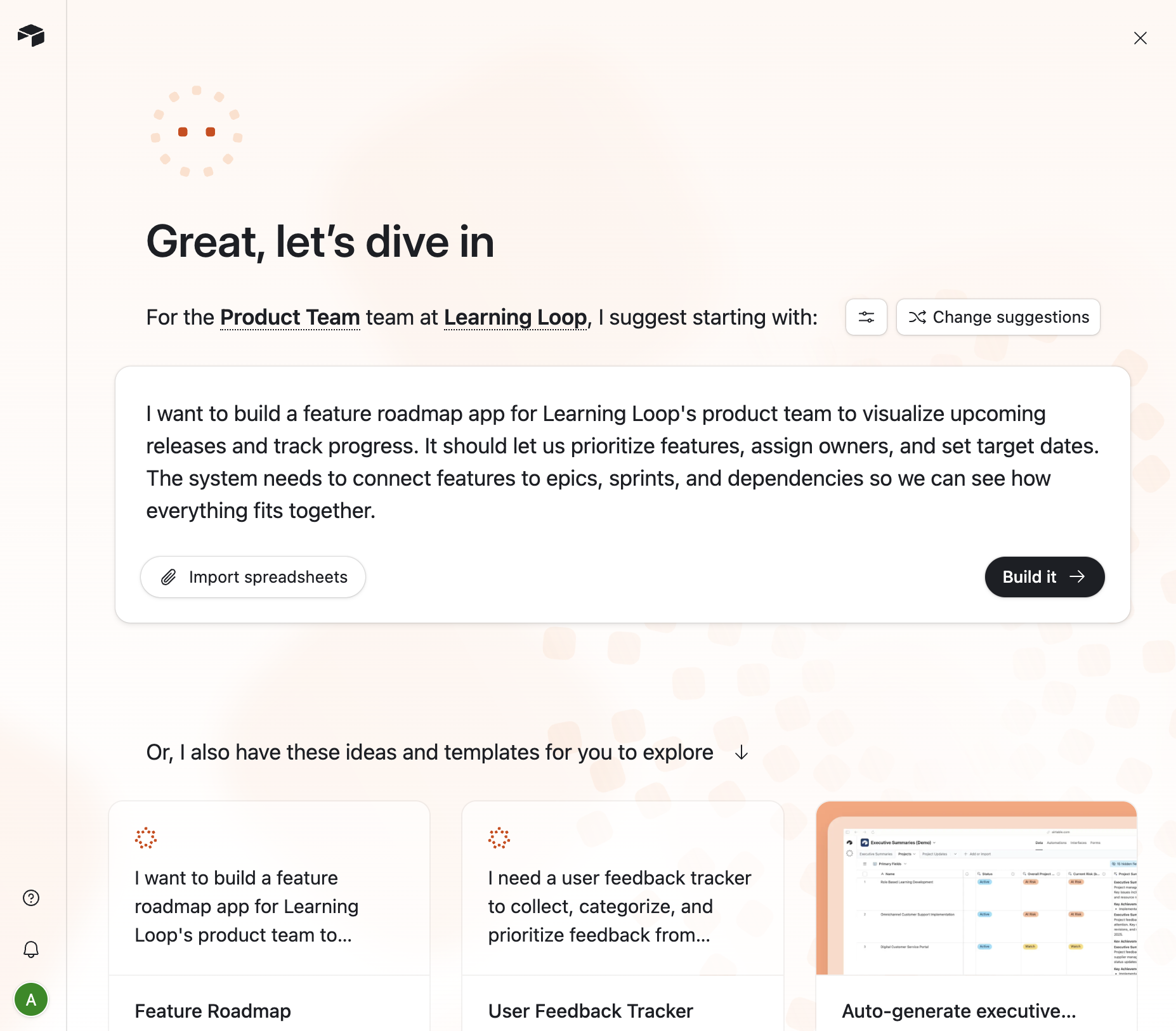
The answers are turned into a starting prompt you can build from or change.
I’m Notion AI. Yeah, another AI … try to contain your excitement.
The same shift shows up elsewhere. Notion introduces its assistant on the welcome screen with three starting tasks and a “Describe your own” box, Canva puts an AI prompt on the home page, and the last question in Figma’s setup lets you choose between the Figma agent, a template or a blank canvas.
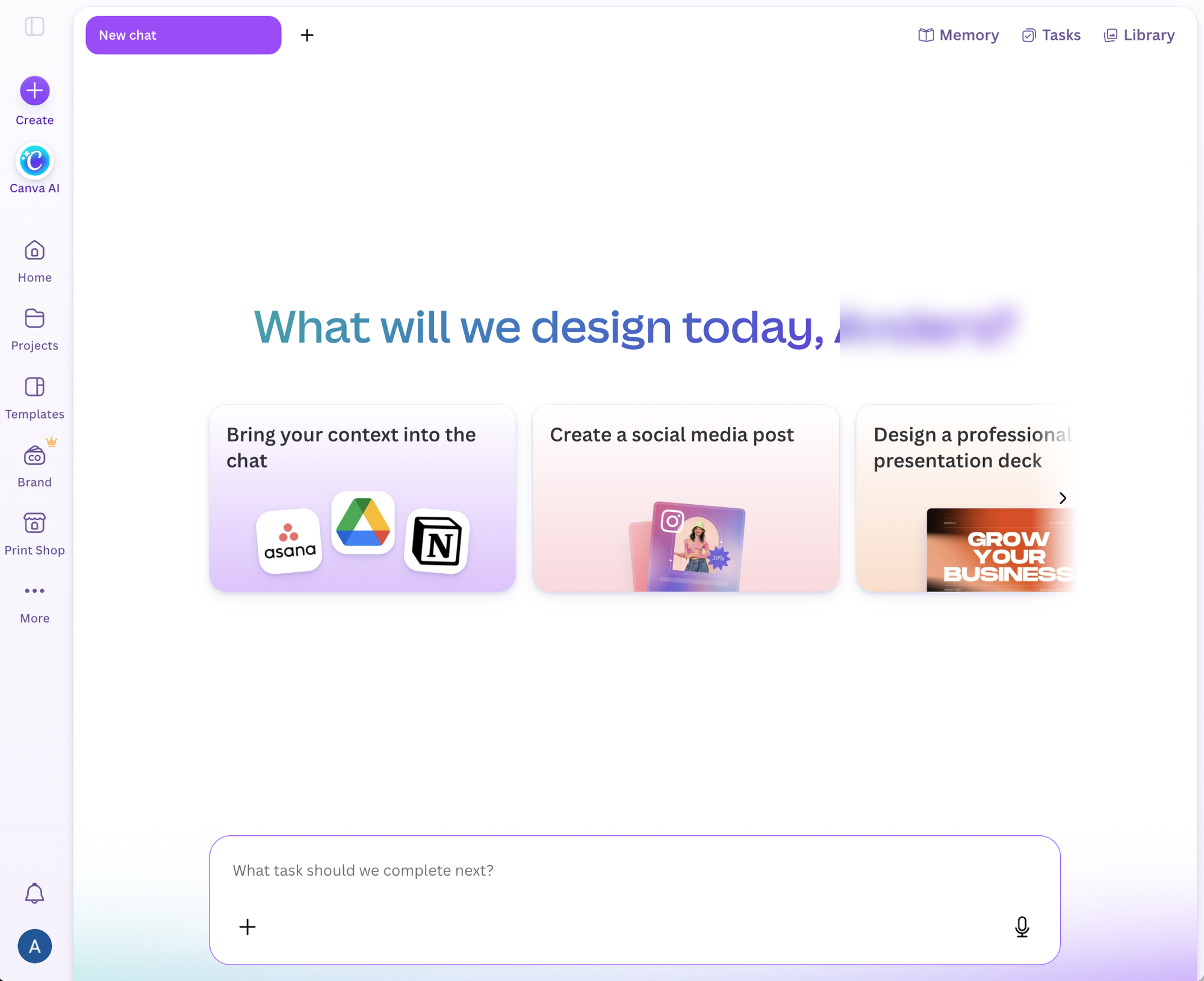
Canva’s AI home offers suggested prompts and asks you to bring your context into the chat.
2. Templates and prompts are converging
Template Gallery has long been the way to avoid a blank page. In these journeys it sits next to a prompt box, and the two are blending.
Related
Template Gallery
Pre-made starting points that help users get going without a blank page.
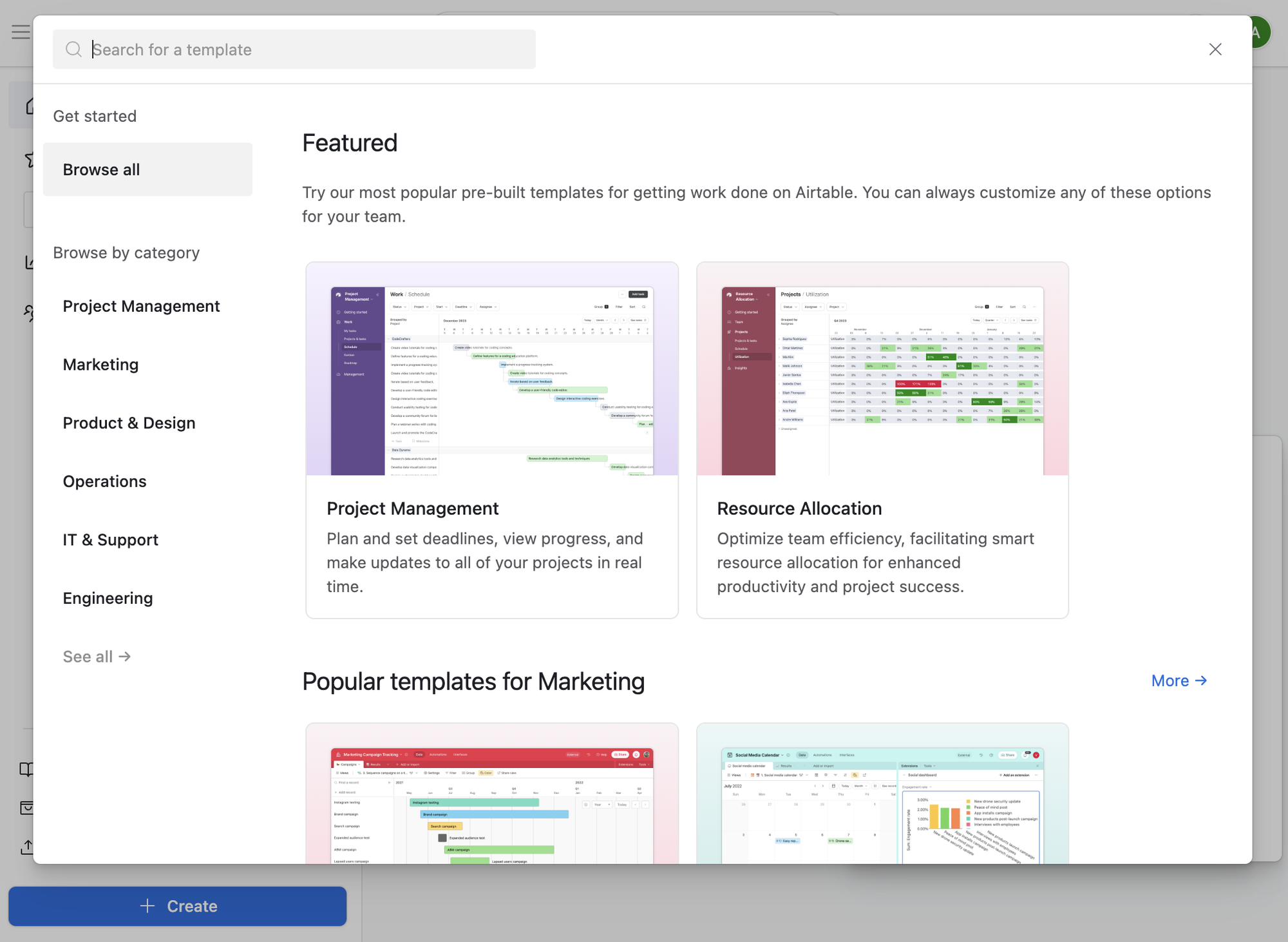
Airtable’s template picker, with categories, a featured row and a one-line description for each template.
Airtable’s suggested prompt comes with ideas and templates right below it. Canva’s template page shows Customise this template with an Edit with AI button directly beneath it. Slack, Mailchimp and Amplitude all present templates inside their setup flows.
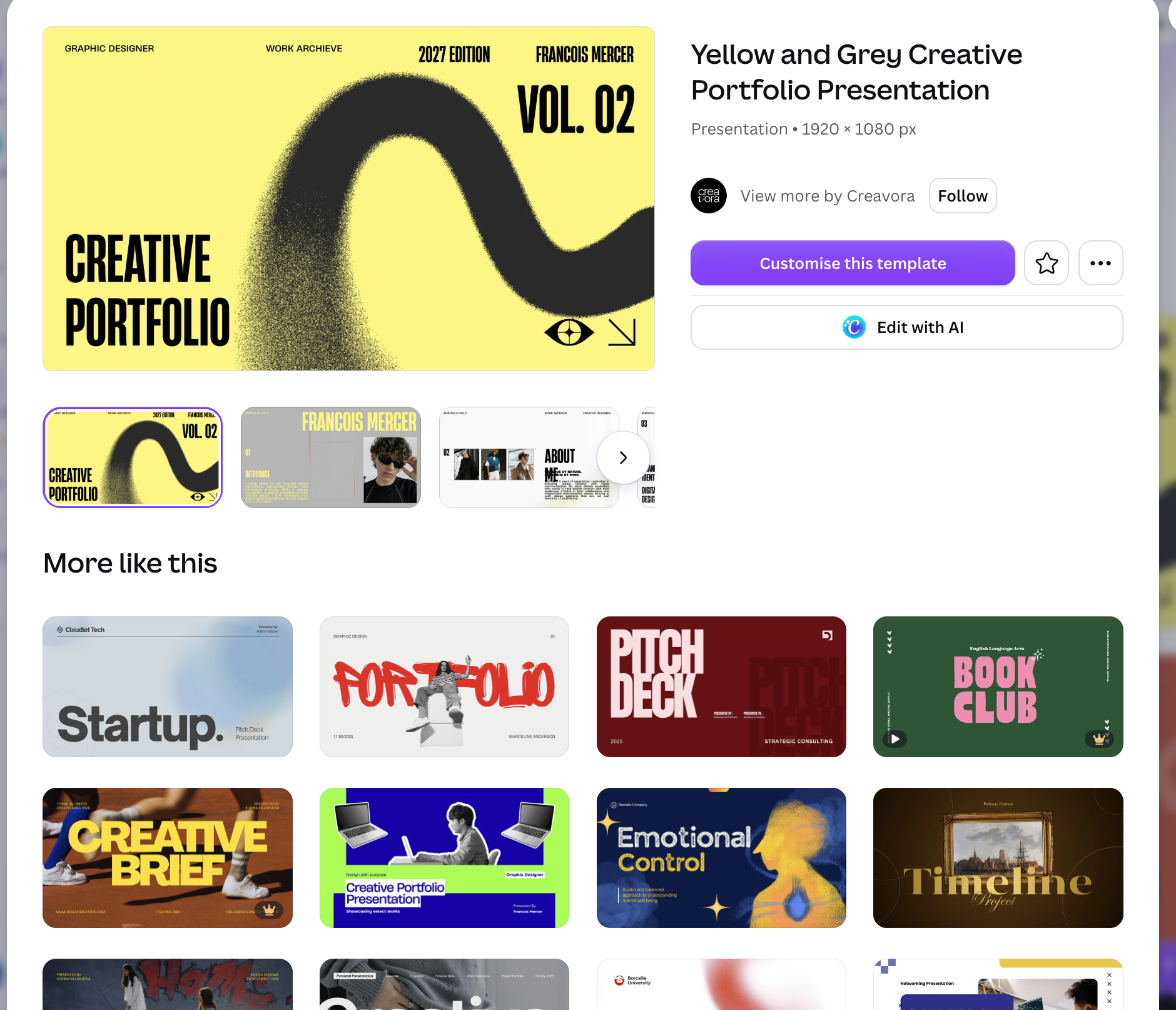
Canva pairs “Customise this template” with “Edit with AI” on the same screen.
The gallery also seems to be moving from browse everything toward chosen for you: Airtable writes its suggested prompt from your answers, and suggested prompts work like clickable templates.
3. Setup is handed to the user’s coding agent
The most surprising screen in the set comes from Amplitude. Next to the usual code snippet, it recommends an AI prompt to run in your coding tool. The prompt reads “Set up Amplitude in the selected app: one real, app-produced first event, ingested into the selected project.” You press Open in Cursor or Copy Prompt, let the agent instrument your app, and Amplitude waits for the first event to arrive. The footer says Waiting for your events…. Finish Setup stays disabled until data flows. An Invite Team option lets you hand the job to a developer instead.
Run this custom prompt in an AI coding tool like Cursor or Claude to set up Amplitude.
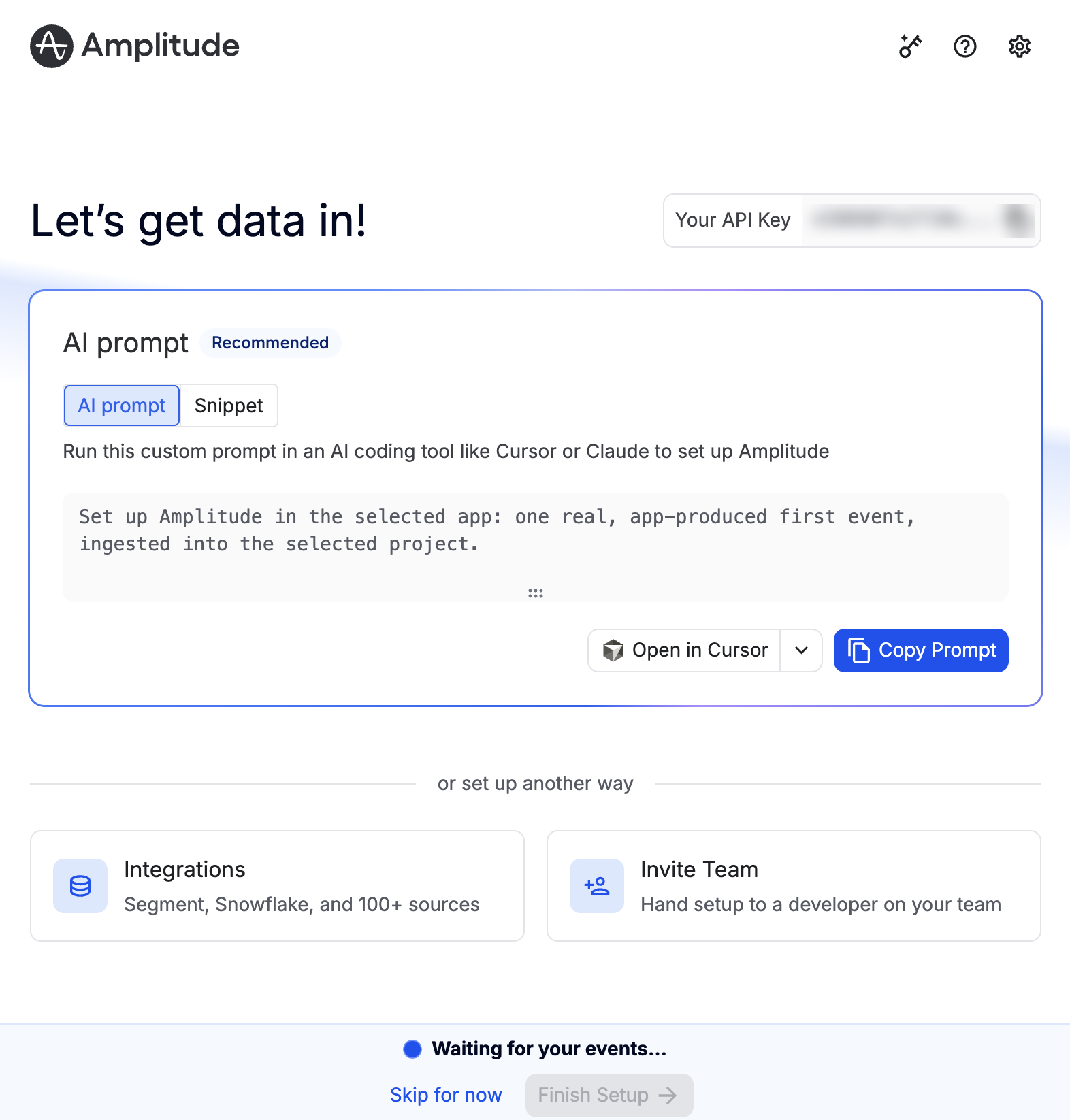
Amplitude asks you to run a prompt in Cursor or Claude to set up tracking. Setup is no longer done in the product.
This is a new kind of Suggested Action. The product does not guide you through the steps. It writes the instructions for another tool and then watches for the result.
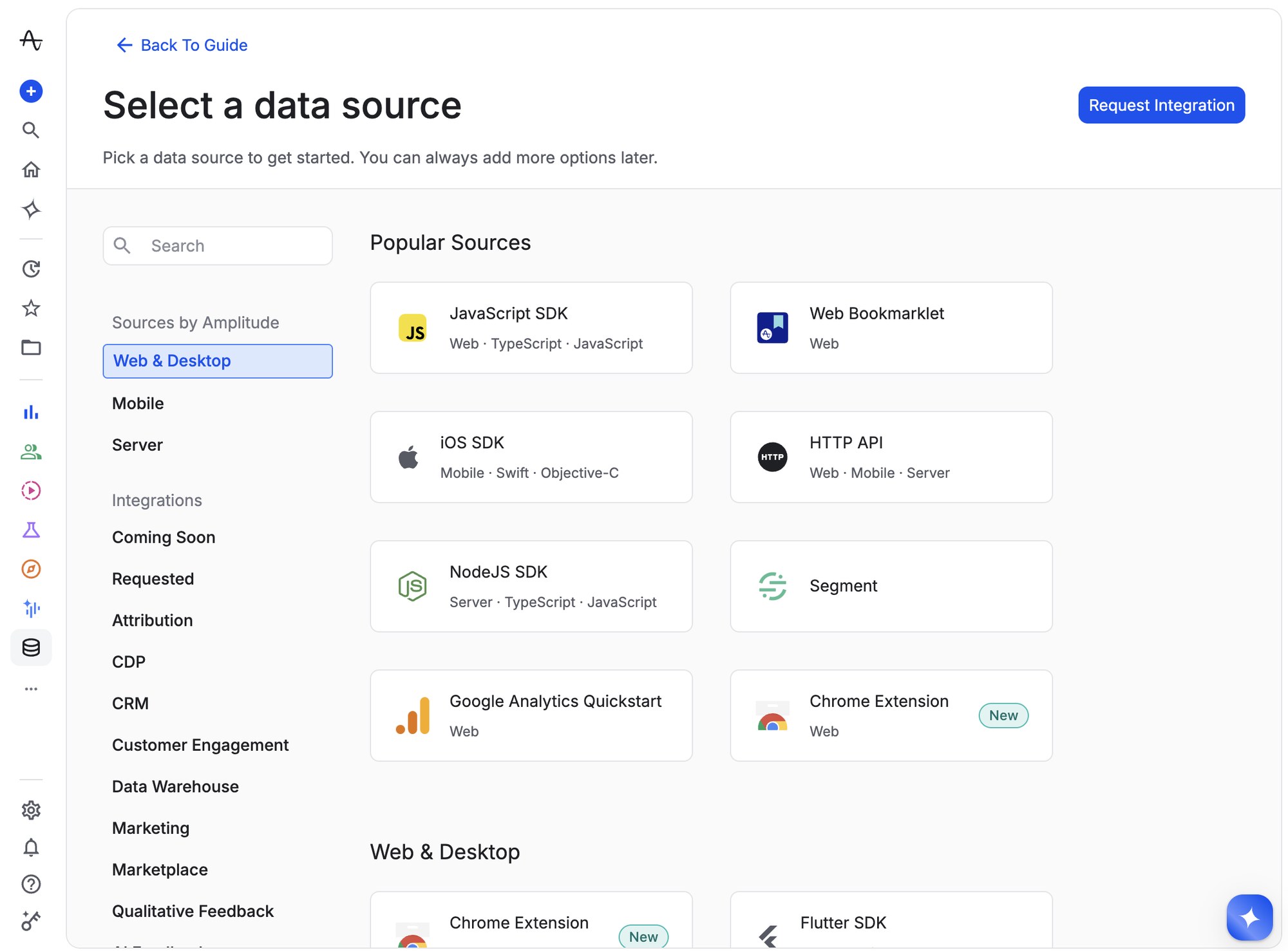
The other route: Amplitude’s list of data sources, grouped by platform, with a search field.
Why this works
- The hard part of setup (code changes) is done by a tool the user already trusts
- Success is defined as a real event arriving, not as a completed form
- The waiting state gives clear feedback, and Skip for now keeps the user in control
4. Connected tools become AI context
AI assistants are only useful when they know something about you. So onboarding now asks you to share context early.
Canva says Bring your context into the chat. Notion offers to tailor your workspace with your actual context and schedule. Mailchimp’s checklist opens with Brand imported! already ticked. Trello asks you to connect a calendar to power its planner.
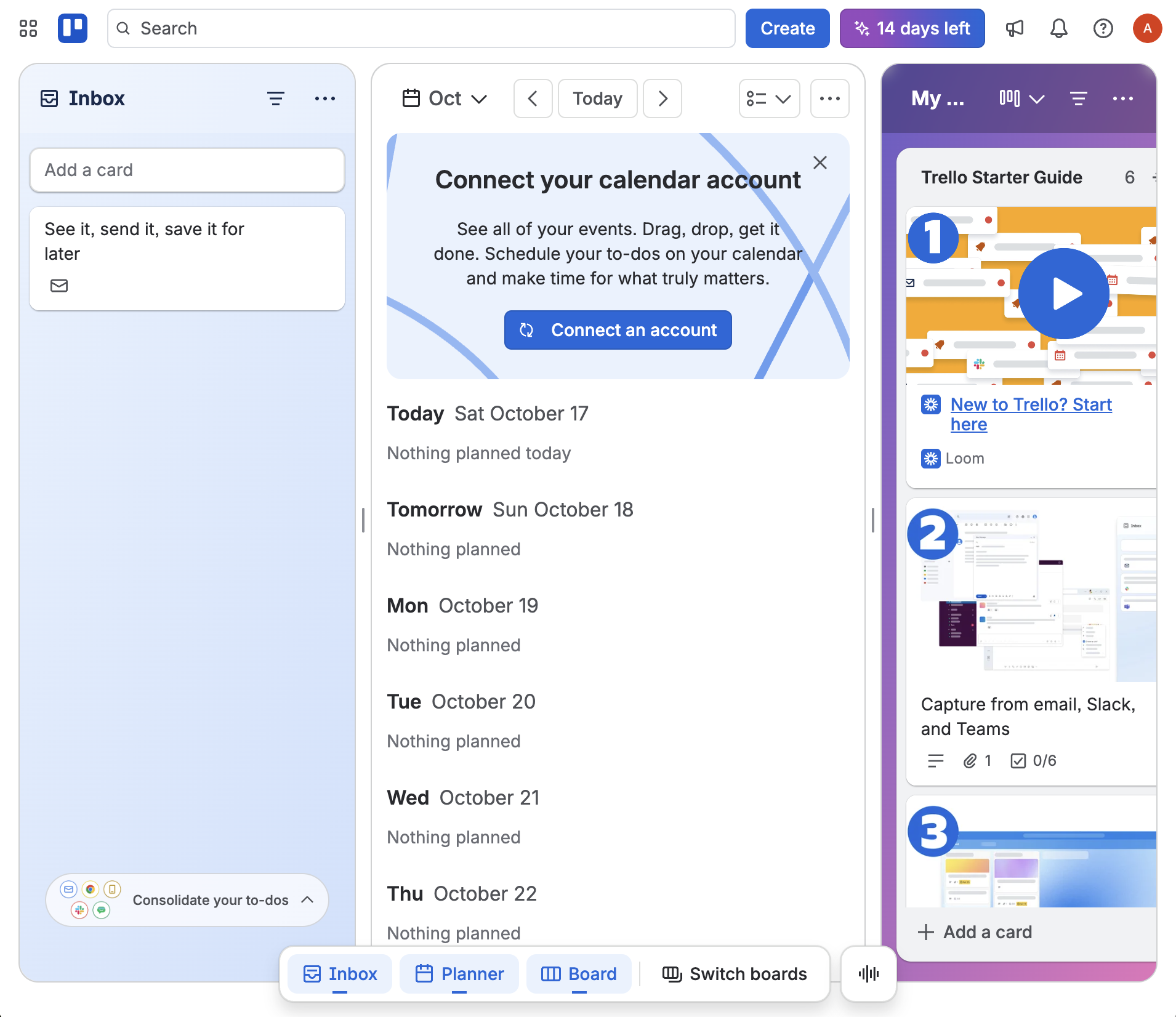
Trello asks to connect a calendar so the planner has something to show.
This turns Connected Accounts from an integrations afterthought into a first-run step, and it makes Smart Prefill a core way to personalize without asking questions.
5. AI is the new paywall, and credits are the meter
The strongest monetization signal across the products is that AI features are what get gated.
Airtable announces that Airtable AI is now included in your trial, but asks you to confirm your email to get access. Its plan table counts AI credits (500 per editor each month on Free, 15,000 per paid user on Team). Trello puts Create board with AI behind Premium. Canva’s Grow announcement leads with AI that knows your brand. Claude shows a session limit and a weekly limit.
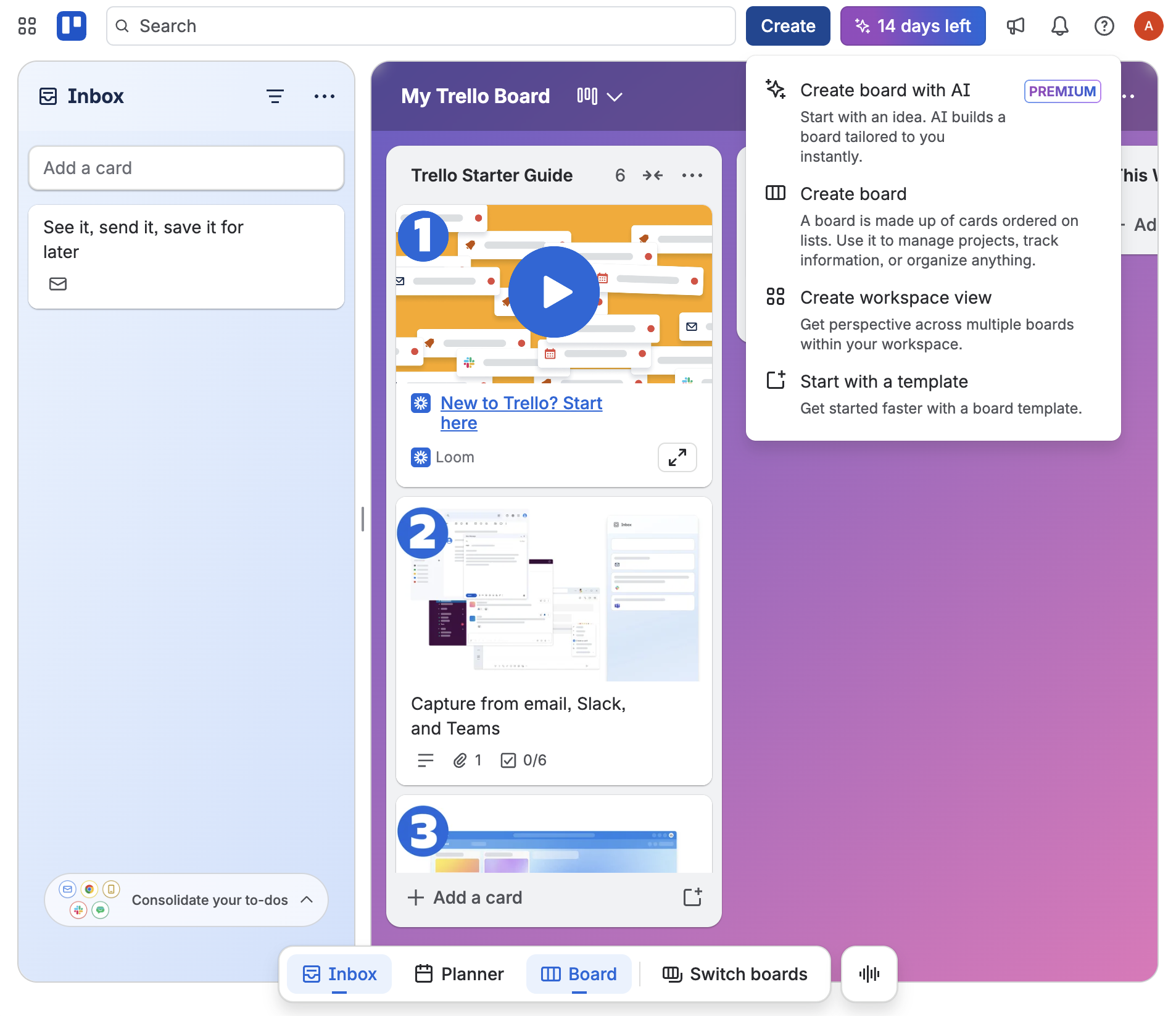
Trello shows the AI option in the Create menu, behind a Premium gate.
This is Feature Gate aimed at AI, and Usage Meter measuring credits or rolling windows instead of storage. Deferred Verification is also used as cost control: you can look around, but the expensive action waits until your email is confirmed.
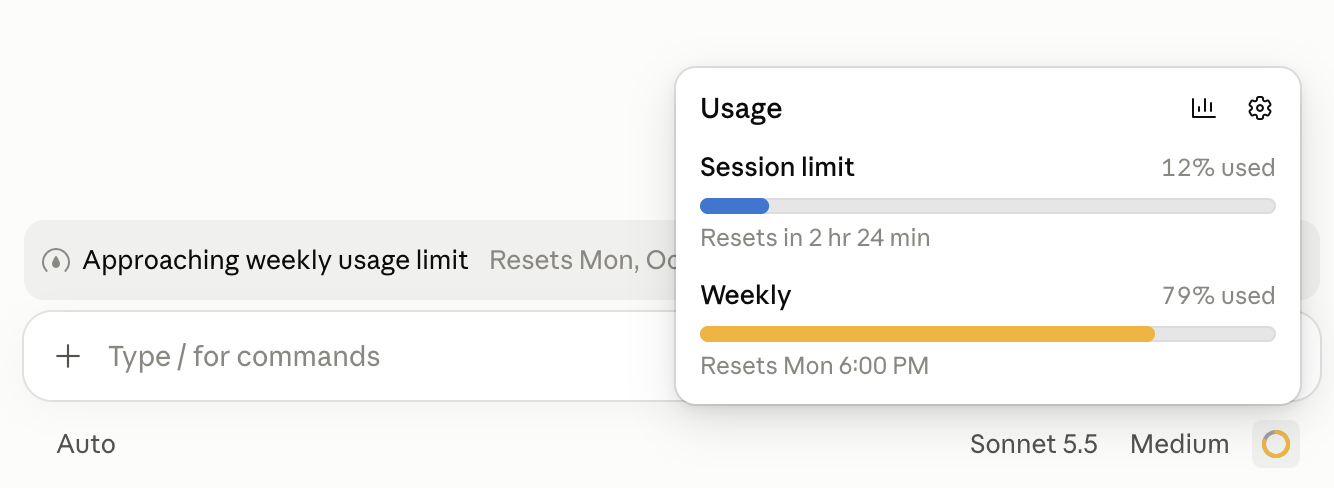
Claude’s usage limits are a meter with a rolling window rather than a fixed total.
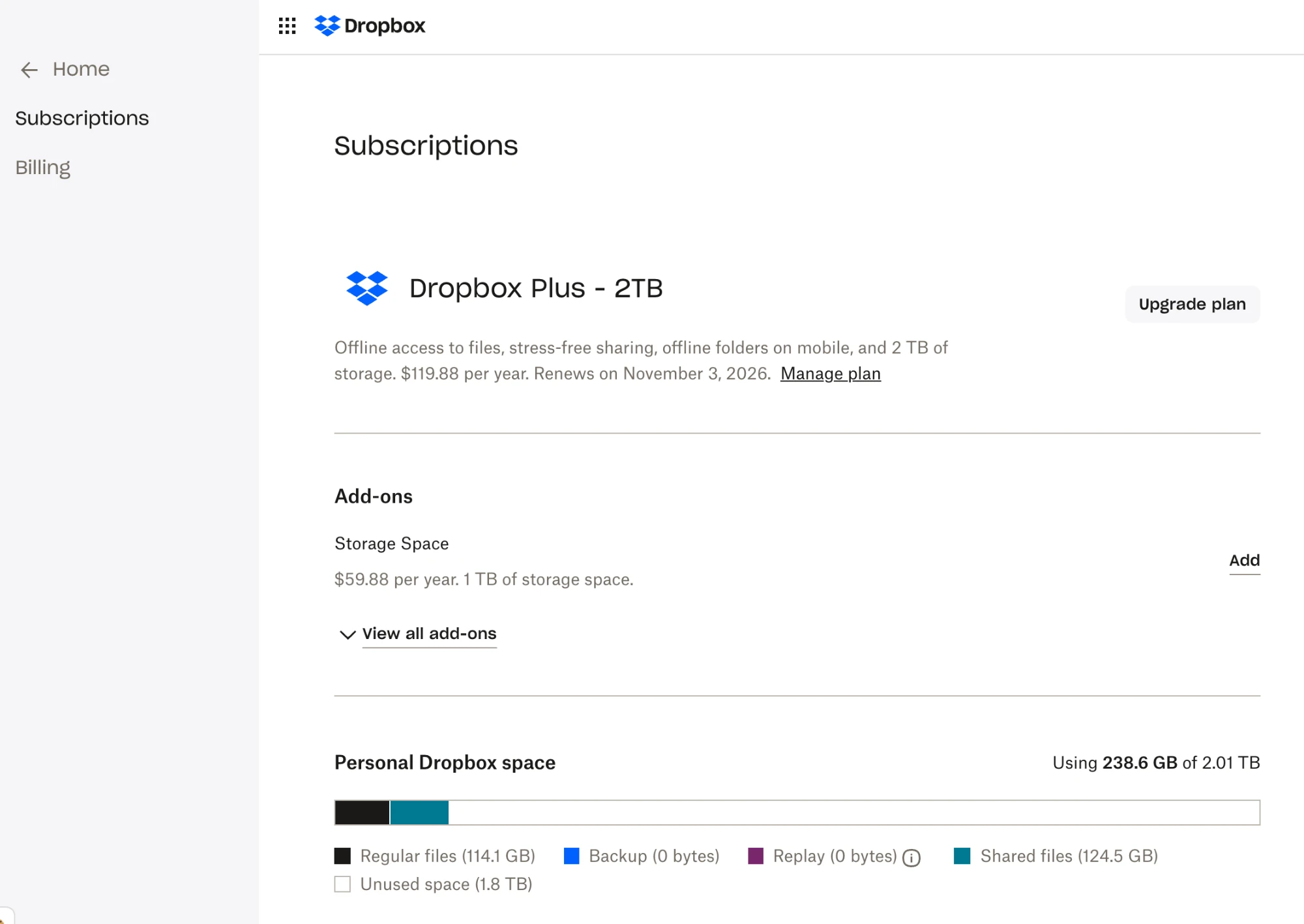
Dropbox’s storage meter, the classic version of the same pattern.
6. Reverse trials come with a persistent label
Airtable and Trello start you on a paid plan and move you to Free when the trial ends. Both keep a label visible all the way through: Trial: 14 days left in every Airtable base and 14 days left in Trello’s header. Trello’s panel also offers to extend the trial to 30 days if you add a payment method. Shopify shows Trial ends in 3 days at the top of its home page.
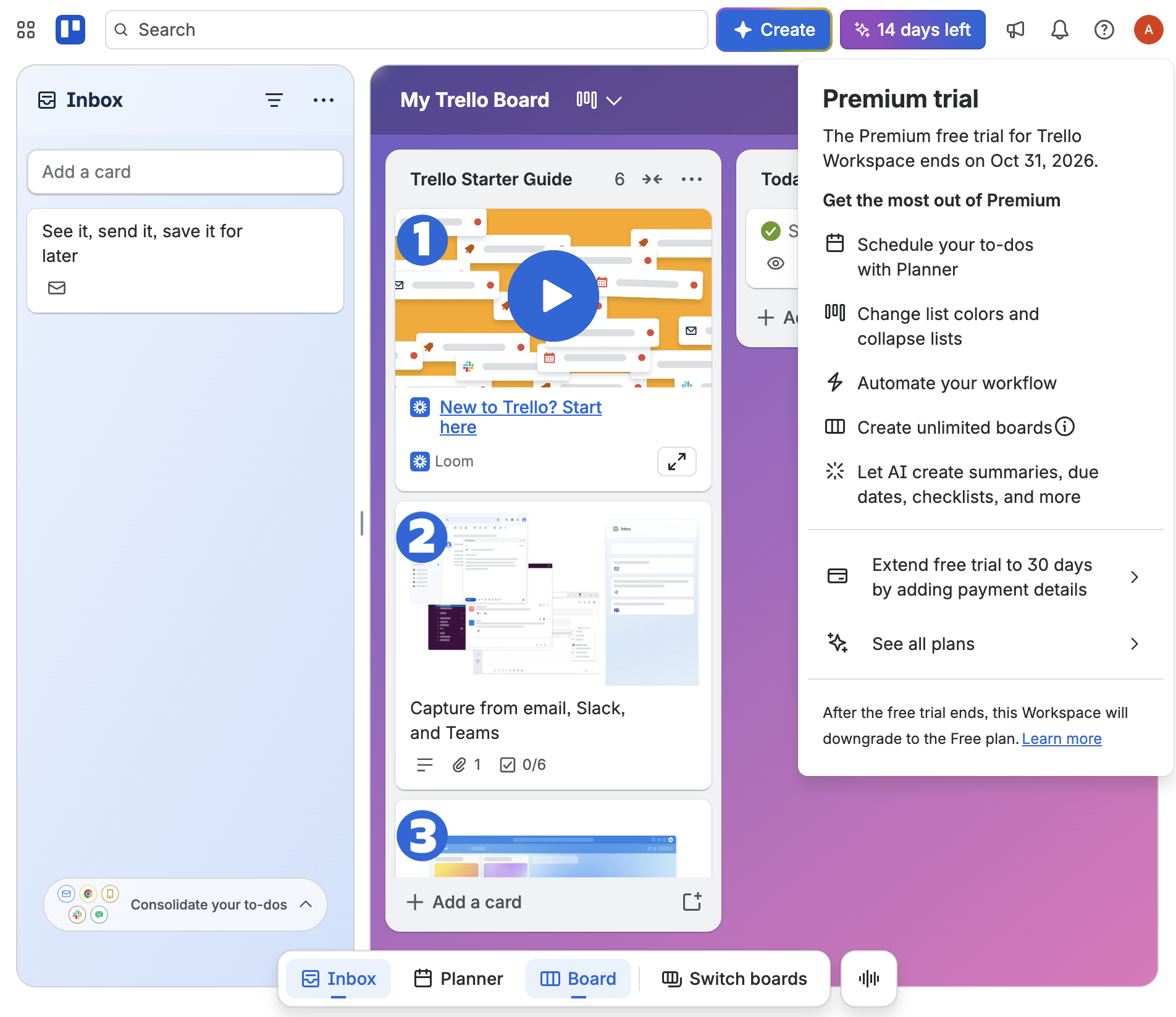
Clicking Trello’s “14 days left” label opens a panel with the end date, what the trial includes, and a note that the Workspace moves to the Free plan afterwards.
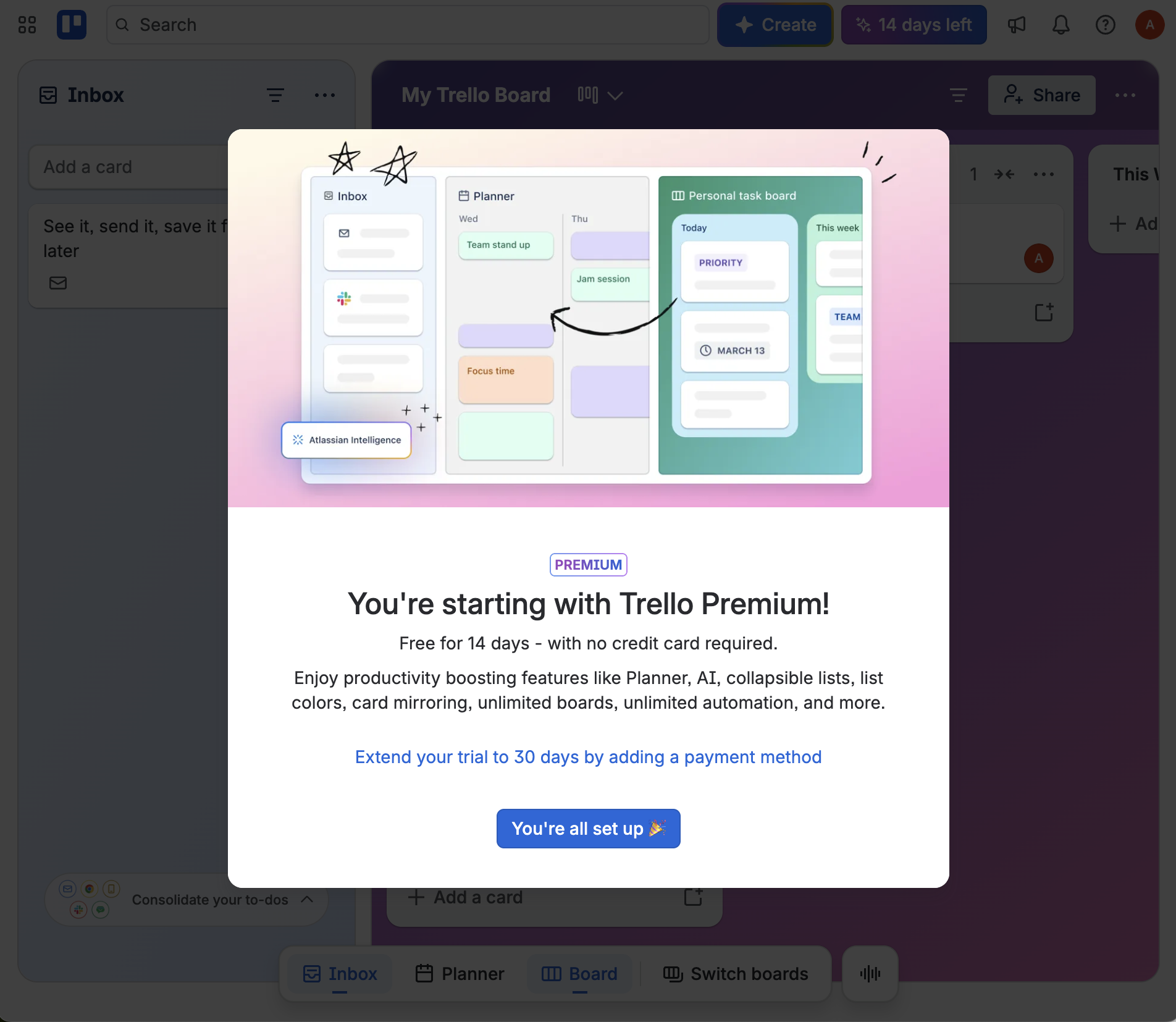
Trello’s trial is free for 14 days with no credit card, and can be extended to 30 days by adding a payment method.
The persistent label is a Trial Countdown. Starting on paid means you try everything first and feel what you lose later, which puts loss aversion to work. Exits are also getting more careful: Netflix offers to pause for up to three months, and Trello (through Atlassian) says “You can cancel the deletion before 31 October 2026” after you delete your account. See Cancellation Flow.
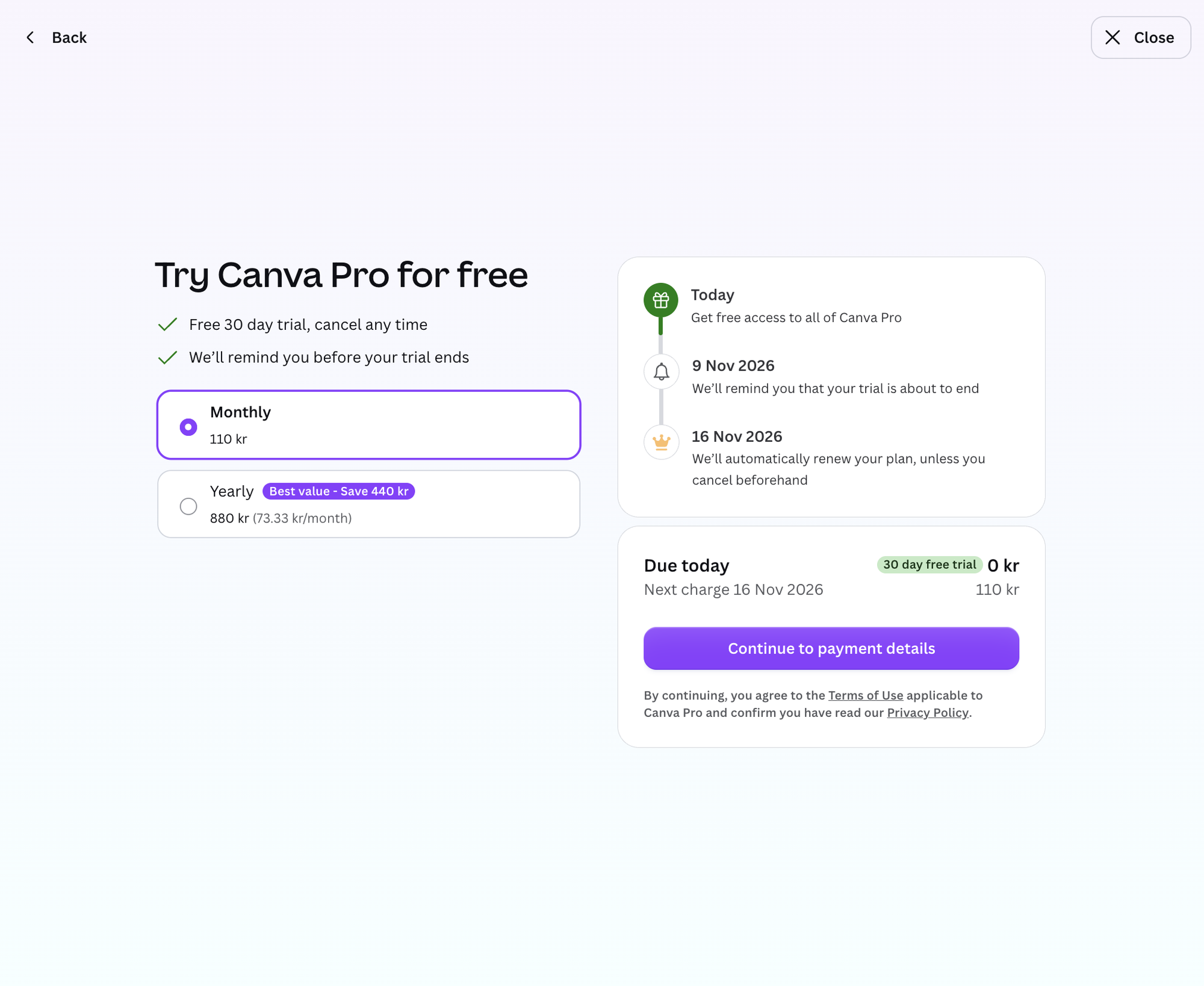
Canva shows a timeline of when the trial reminder and charge happen.
7. Less friction at the door
Sign-in options are drifting toward passwordless. Several products avoid passwords at the start. Trello and Notion send a six-digit code, Netflix sends a link and keeps Create password instead as the escape, and Canva and Amplitude suggest a passkey. Social Login now includes Continue with ChatGPT next to Google at Airtable, Notion and Vercel.
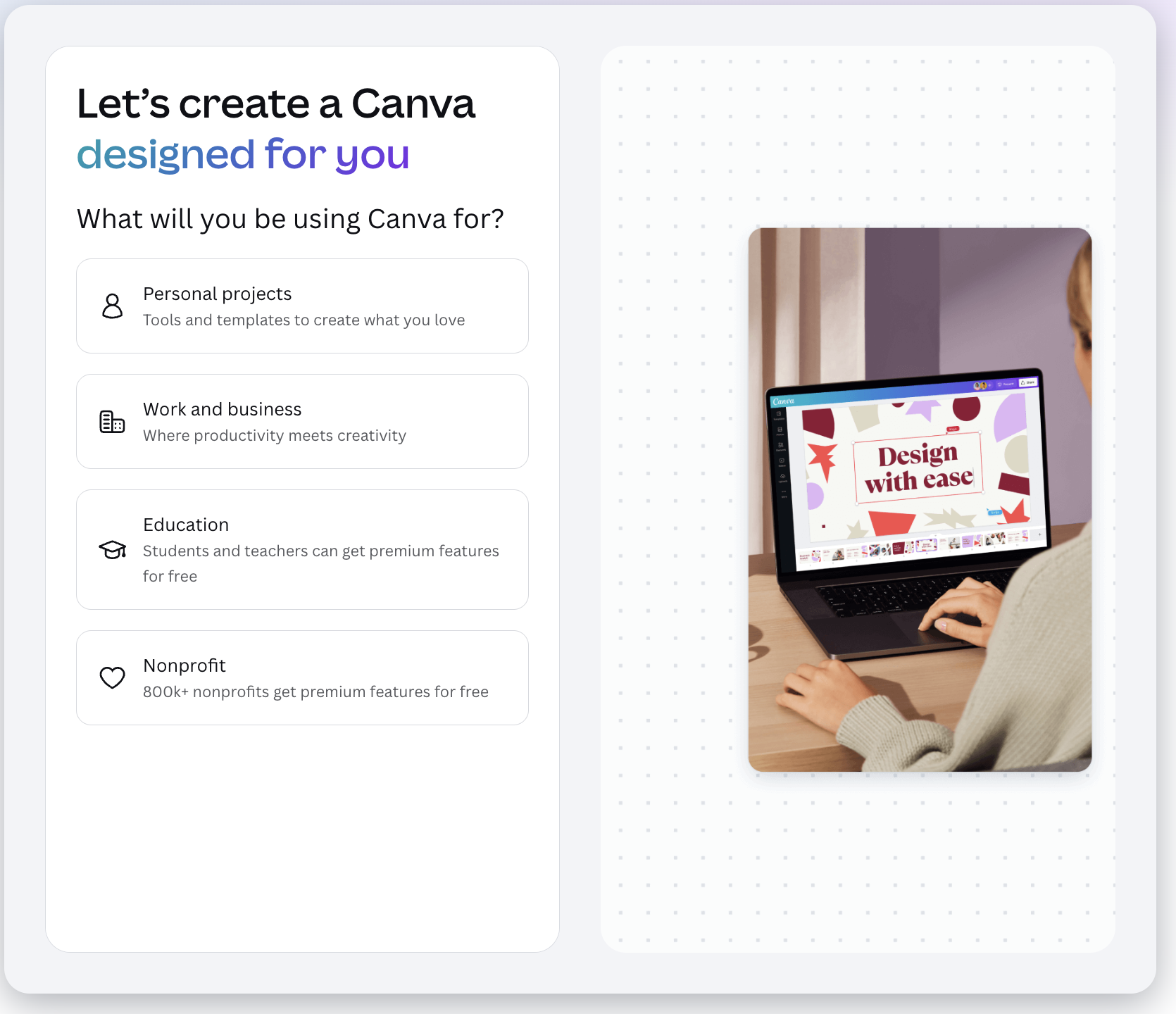
Canva asks a single question and gives each answer a one-line description.
Questions come with a reason and a way out. Notion asks for Gmail and Google Calendar and says why (“Tailor your workspace with your actual context and schedule”), with a Skip button. Shopify’s chips come with Skip and Back, and Notion’s goal question offers “Not sure, I’m exploring”.
8. Onboarding never ends
Onboarding used to be a sequence you finished. Now it lives inside the features. Mailchimp shows 0/5 tasks done inside Automations, Airtable follows its welcome with a Getting started checklist (0/4) that includes automating work with field agents, and Figma runs a later tour that points out new AI features in the editor. Badges marked New and hotspots announce each addition.
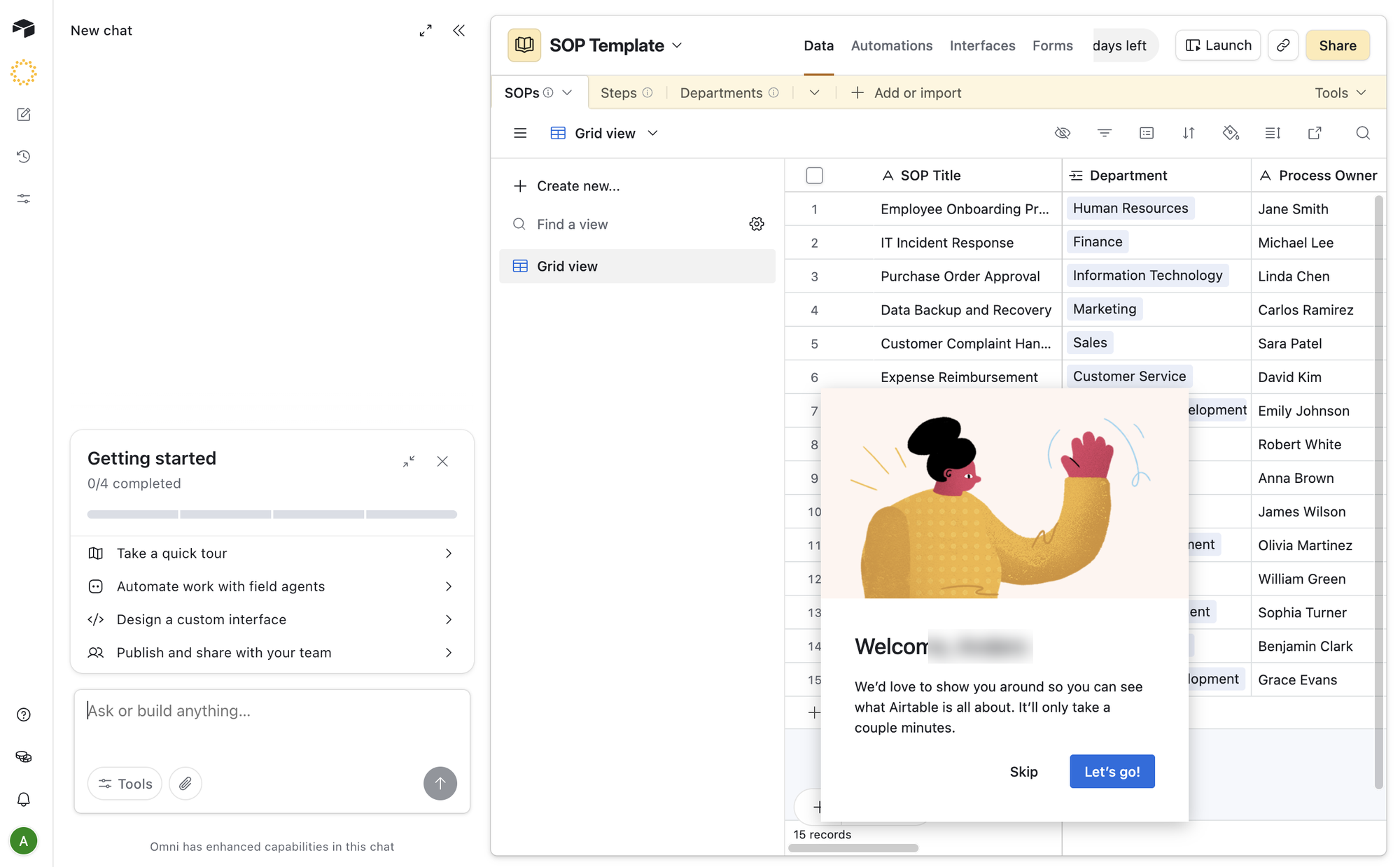
Airtable’s “Getting started” checklist: take a tour, automate work with field agents, design an interface and share with your team.
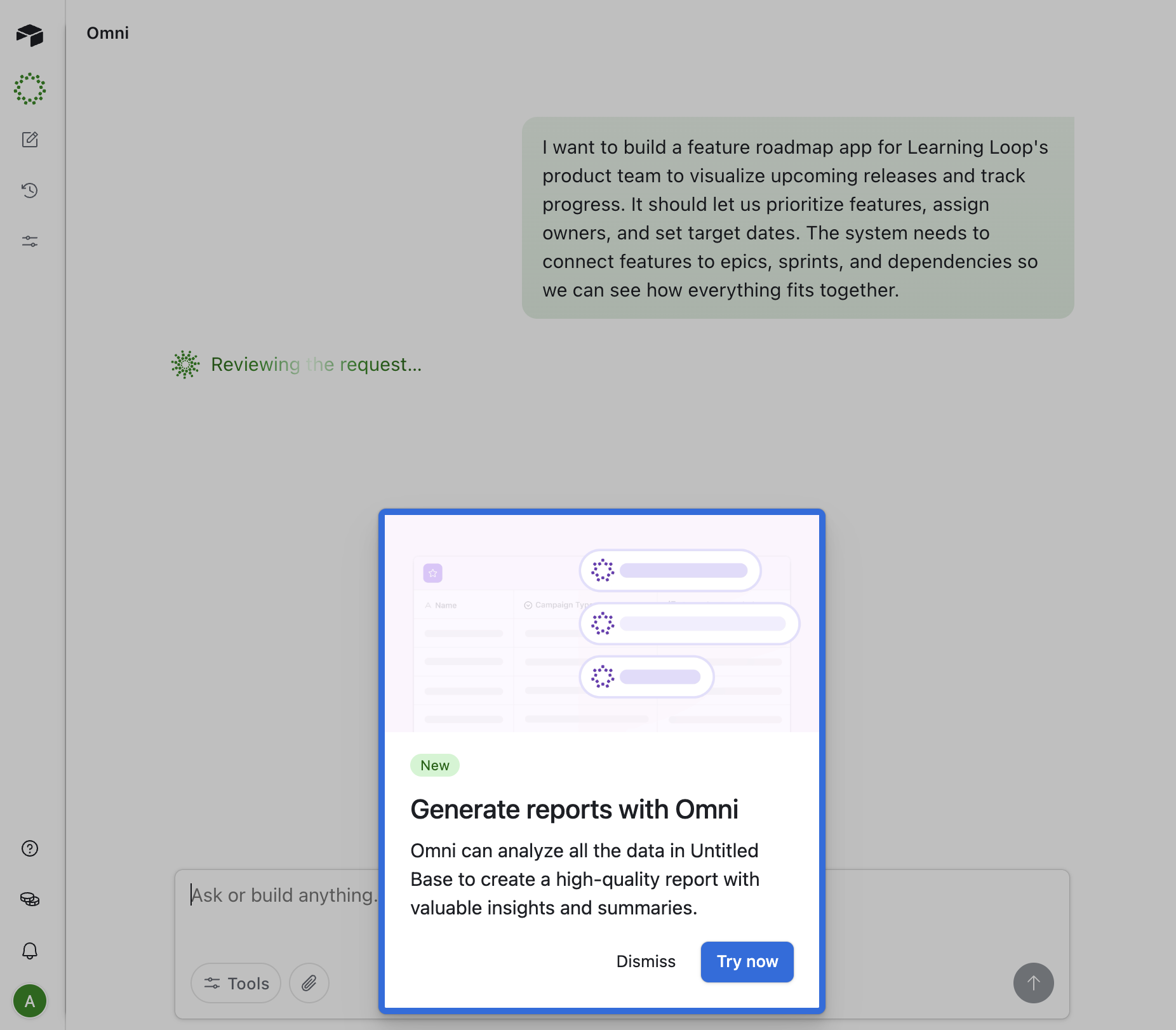
A “New” card inside Airtable introduces report generation with Omni while the user is already working in the assistant.
The Onboarding Checklist and Feature Spotlight are now used per feature, not per product.
What this means for onboarding
The first screen is now a decision about where to put effort. Do you want the user to describe, pick, or configure? In the best examples all three are on offer, and the product learns from the choice.
Time to first value shifts to "time to first prompt result". If the AI produces something half right, users need a clear way to review, change and undo it. This is the biggest risk in the new flows: a convincing but wrong setup is harder to spot than an empty one.
Context is the new currency. The more you let users connect and import, the better the first result, but you must say what you read and why.
Setup moves outside your product. When your onboarding hands work to another agent, you cannot see what happens in between. Design the waiting state and the success signal with care.
Gating AI is a test of trust. If the first AI result is free and good, an upgrade prompt feels fair. If the gate comes before any result, it feels like a wall.
Questions to ask in your own onboarding
- What is the one thing a new user should see produced within the first minute?
- Can they choose between describing, picking a template and starting blank?
- If AI builds something, can they review, edit and undo it?
- Do you explain why you ask for access to their tools or data?
- Is the free path to a first result visible before any paywall?
Patterns changing shape
Existing patterns are being reused in new ways:
- Personalization Form, Suggested Prompts and Wizard are merging into conversational setup
- Blank Slate becomes a conversation with cards
- Welcome Screen becomes the assistant introducing itself
- Template Gallery shifts from browsing to chosen-for-you
- Usage Meter tracks credits and rolling windows
- Feature Gate targets AI features
- Deferred Verification acts as cost control
Most of what looks new is a variation of a pattern we already have, so we treat them as variations rather than separate patterns:
- Conversational Setup is a variation of Wizard and Personalization Form. A chat or prompt replaces the setup form, and Suggested Prompts take the place of preset answers.
- Agent Handoff is a variation of Suggested Action. The product writes a prompt for the user’s own coding agent and waits for the first event to arrive.
- Context Ingestion is a variation of Smart Prefill and Connected Accounts. The product reads the user’s site, calendar or workspace to personalize the first result.
- AI Credits Meter is a variation of Usage Meter. The balance is AI credits or a rolling window instead of storage, and it is tied to the plan.
- Reverse Trial is a variation of Trial Countdown. The user starts on paid, falls back to free, and sees a persistent label of what remains.
- Passkey Prompt is a variation of Magic Login Link. It is another passwordless option, offered as a suggestion after the first sign-in.
We will describe these as variations in the existing pattern pages once we have enough strong examples of each.
Related
Onboarding patterns
All onboarding patterns, grouped into getting in, setting up, finding your way, first value, AI features, and upgrades and exits.
Sources
Screens captured from the sign-up journeys of Airtable, Amplitude, Canva, Figma, Mailchimp, Netflix, Notion, Shopify, Slack and Trello in October 2026, a few Google screens, and usage screens from Claude and Dropbox. Launch dates of individual features cannot be read from the screens, so we make no claims about who did what first.
